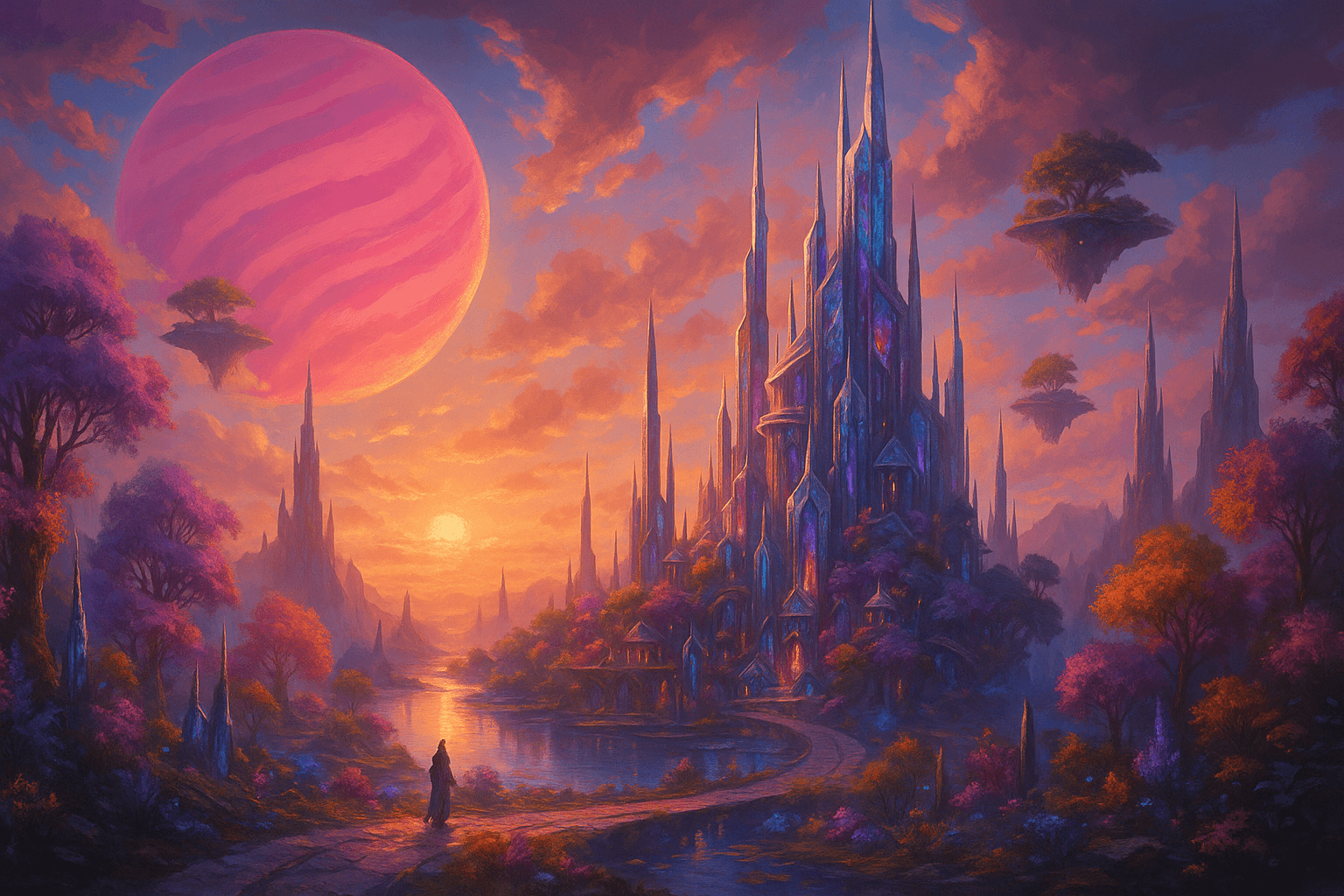
Planet Description
Elyria is a unique terrestrial planet distinguished by anomalous low-density geological formations and localized gravitational variations that result in buoyant landmasses suspended within its dense atmospheric column. The crust contains high concentrations of crystalline silica and piezoelectric quartz minerals, which produce measurable electromagnetic resonance when subjected to atmospheric pressure differentials. Surface structures exhibit advanced acoustic properties due to the planet's atmospheric density (1.15 kg/m³ at sea level) and composition, enabling efficient sound propagation. The atmosphere's elevated neon content (30 ppm) contributes to distinctive luminescent phenomena within crystalline geological structures. Tectonic analysis reveals fault lines rich in optically-active mineral deposits that refract incident stellar radiation.
Planet Statistics
Orbital Data:
| Stat | Value |
|---|
| Mass | 6.10 × 10^24 kg (≈ 1.02 Earth masses) |
| Gravity | 9.9 m/s² (≈ 1.01 g; supports elegant architecture) |
| Orbital Period | 365.8 days (a year of symphonic seasons) |
| Rotational Period | 23.1 hours (day–night cycles tuned like melodies) |
Atmospheric Conditions:
| Stat | Value |
|---|
| Nitrogen | 76.8 % by volume |
| Oxygen | 21.5 % by volume |
| Argon | 1.0 % by volume (carries the refrains of wind instruments) |
| Carbon Dioxide | 21.5 % by volume |
| Water Vapour | 0.66 % by volume (mists that amplify sound) |
| Neon | 30 ppm (glints within crystal city spires |
Geological Data:
| Stat | Value |
|---|
| Mean Radius | 6,400 km (≈ 1.00 Earth radii) |
| Equilateral Circumference | 40,200 km |
| Volume | 1.10 × 10^12 km³ |
| Surface Area | 515 million km² |
Hydrological Data:
| Stat | Value |
|---|
| Mist and Cloud Coverage | ~60 % (entirely draped in soft vapors) |
| Lakes and Inland Seas | 14 % (canals flowing past floating isles) |
| Ice and Crystal Formations | 4 % (frosted amphitheaters on high peaks) |
| Average Lake Depth | 3,600 m |
| Total Water Volume | 1.25 billion km³ |
Magnetic and Geophysical Data:
| Stat | Value |
|---|
| Geothermal Gradient | 18–38 °C/km (warm underground grottoes tuned by tonal springs) |
| Magnetic Field Strength | 3.2 × 10⁻⁵ T (harmonic resonance with lithic crystals) |
Auroral and Geomagnetic Data:
| Stat | Value |
|---|
| Halo Storm Cycle | ~32 days (light ribbons that pulse as living music) |
| Skyglow Arcs | continuous multi-hued arcs dancing at twilight |
| Magnetic Reconnection Events | synchronized with dawn’s first chorus |
Planetary Motion Data:
| Stat | Value |
|---|
| Halo Storm Cycle | 0.009 (nearly circular, for stable creative rhythm) |
| Obliquity | 18° (graceful seasonal shifts in light and color) |
| Precession Period | 25,500 years (long-term evolution of cultural epochs) |
Tectonic Motion Data:
| Stat | Value |
|---|
| Seismic Wave Speed | 6.4 km/s (through crystal-infused bedrock) |
| Plate Boundary Length | ~55,000 km (fault lines rich in artistic mineral veins) |
| Quakes per Year | ~9 million (mostly gentle “stone-song” tremors) |
Solar and Stellar Data:
| Stat | Value |
|---|
| Host Star Luminosity | 0.98 L☉ (a gentle, golden-hued sun) |
| Star Surface Temperature | 5,650 K (soft light ideal for artists) |
| Solar Irradiance | 1,320 W/m² (filtered through artful cloudscapes) |
Surface Preview