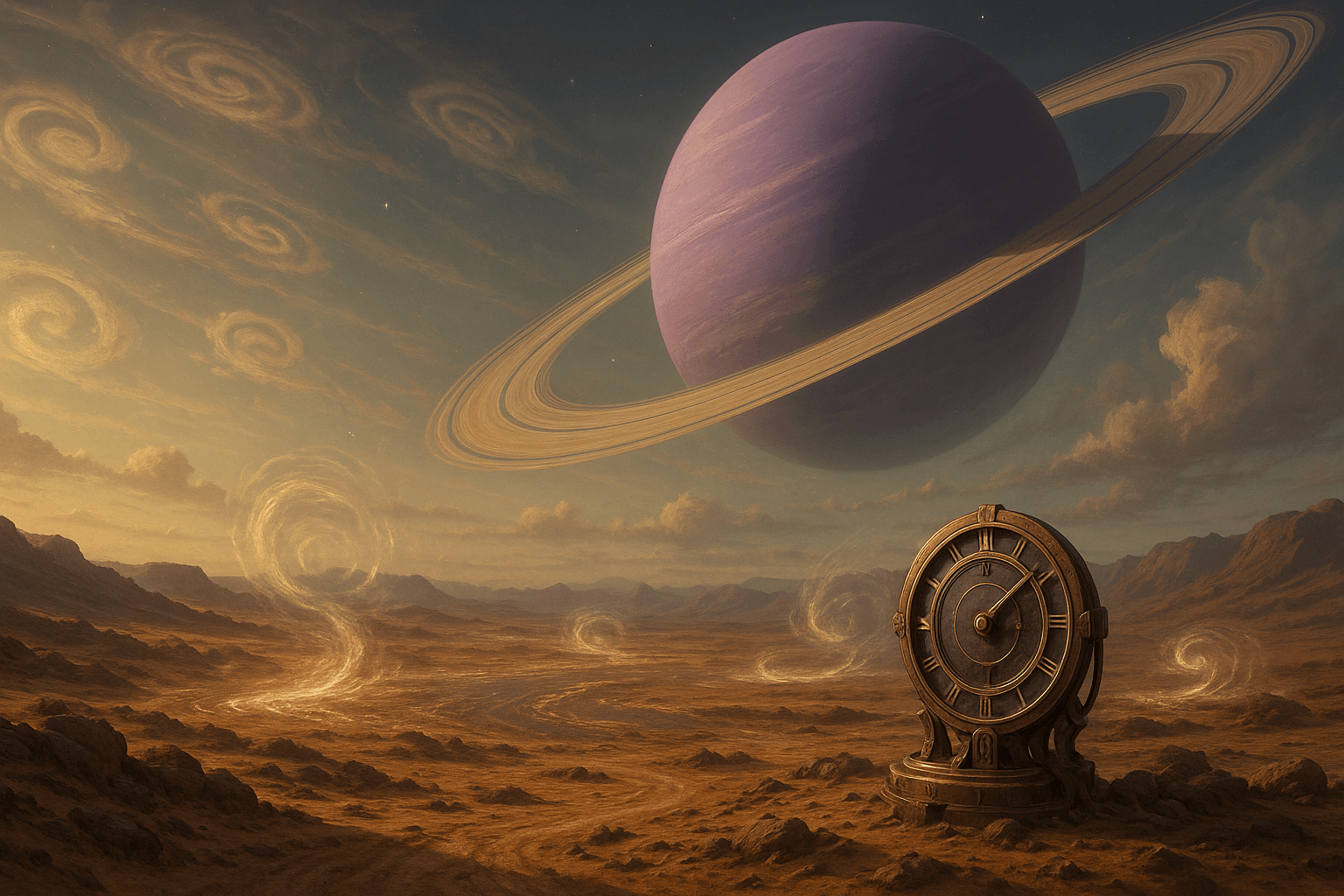
Planet Description
Kairos is a super-Earth class exoplanet with mass 1.39 times that of Earth, characterized by elevated concentrations of rare atmospheric gases including krypton (15 ppm) that exhibit unique quantum properties under specific electromagnetic conditions. The planet's extended orbital period (442.0 days) and rotation cycle (27.5 hours) create pronounced diurnal and seasonal variations. Geological features include massive igneous rock formations and megalithic structures composed of dense metalite alloys. The chrono-magnetosphere exhibits periodic fluctuations synchronized with solar activity from its K-type host star. Subsurface thermal gradients (22-45°C/km) indicate significant geothermal activity, while atmospheric krypton concentrations support advanced spectroscopic research applications.
Planet Statistics
Orbital Data:
| Stat | Value |
|---|
| Mass | 8.30 × 10^24 kg (≈ 1.39 Earth masses) |
| Gravity | 12.5 m/s² (≈ 1.27 g; steady underfoot despite temporal flux) |
| Orbital Period | 442.0 days (one “great cycle” of seasons and epochs) |
| Rotational Period | 27.5 hours (each day marked by a “Chrono-Signal” event) |
Atmospheric Conditions:
| Stat | Value |
|---|
| Nitrogen | 72.0 % by volume |
| Oxygen | 22.5 % by volume |
| Argon | 3.0 % by volume (stable buffer for chronal reactors) |
| Carbon Dioxide | 22.5 % by volume |
| Krypton | 15 ppm (used in time-manipulation technologies) |
| Neon | 100 ppm (faint glow heralding temporal shifts) |
Geological Data:
| Stat | Value |
|---|
| Mean Radius | 7,400 km (≈ 1.16 Earth radii) |
| Equilateral Circumference | 46,500 km |
| Volume | 1.70 × 10^12 km³ |
| Surface Area | 690 million km² |
Hydrological Data:
| Stat | Value |
|---|
| Mist and Cloud Coverage | 50 % (“Tide of Eras” currents that ebb in cycles) |
| Lakes and Inland Seas | 18 % (flow in phase with lunar–solar chronometer) |
| Ice and Crystal Formations | 5 % (regions where time moves more slowly) |
| Average Ocean Depth | 3,800 m (depths echo past echoes) |
| Total Water Volume | 1.10 billion km³ |
Magnetic and Geophysical Data:
| Stat | Value |
|---|
| Geothermal Gradient | 22–45 °C/km (chronal hotspots fuel temporal engines) |
| Magnetic Field Strength | 3.8 × 10⁻⁵ T (syncs with planet’s chrono-magnetosphere) |
Auroral and Geomagnetic Data:
| Stat | Value |
|---|
| Chrono Auroral Cycle | ~33 days (waves of light marking micro-epochs) |
| Twilight Resonance Band | long arcs of shifting color at dawn/dusk transition |
| Magnetic Reconnection Events | pulses in sync with the planet’s “Hour Signal |
Planetary Motion Data:
| Stat | Value |
|---|
| Halo Storm Cycle | 0.009 (nearly circular, for stable creative rhythm |
| Obliquity | 18° (graceful seasonal shifts in light and color) |
| Precession Period | 25,500 years (long-term evolution of cultural epochs |
Tectonic Motion Data:
| Stat | Value |
|---|
| Seismic Wave Speed | 6.4 km/s (through crystal-infused bedrock) |
| Plate Boundary Length | ~55,000 km (fault lines rich in artistic mineral veins) |
| Quakes per Year | ~9 million (mostly gentle “stone-song” tremors) |
Solar and Stellar Data:
| Stat | Value |
|---|
| Host Star Luminosity | 0.95 L☉ (a slightly dimmer sun to stabilize chronal flux) |
| Star Surface Temperature | 5,650 K (steady light to anchor time-readings) |
| Solar Irradiance | 1,250 W/m² (filtered through a temporal resonance haze) |
Surface Preview