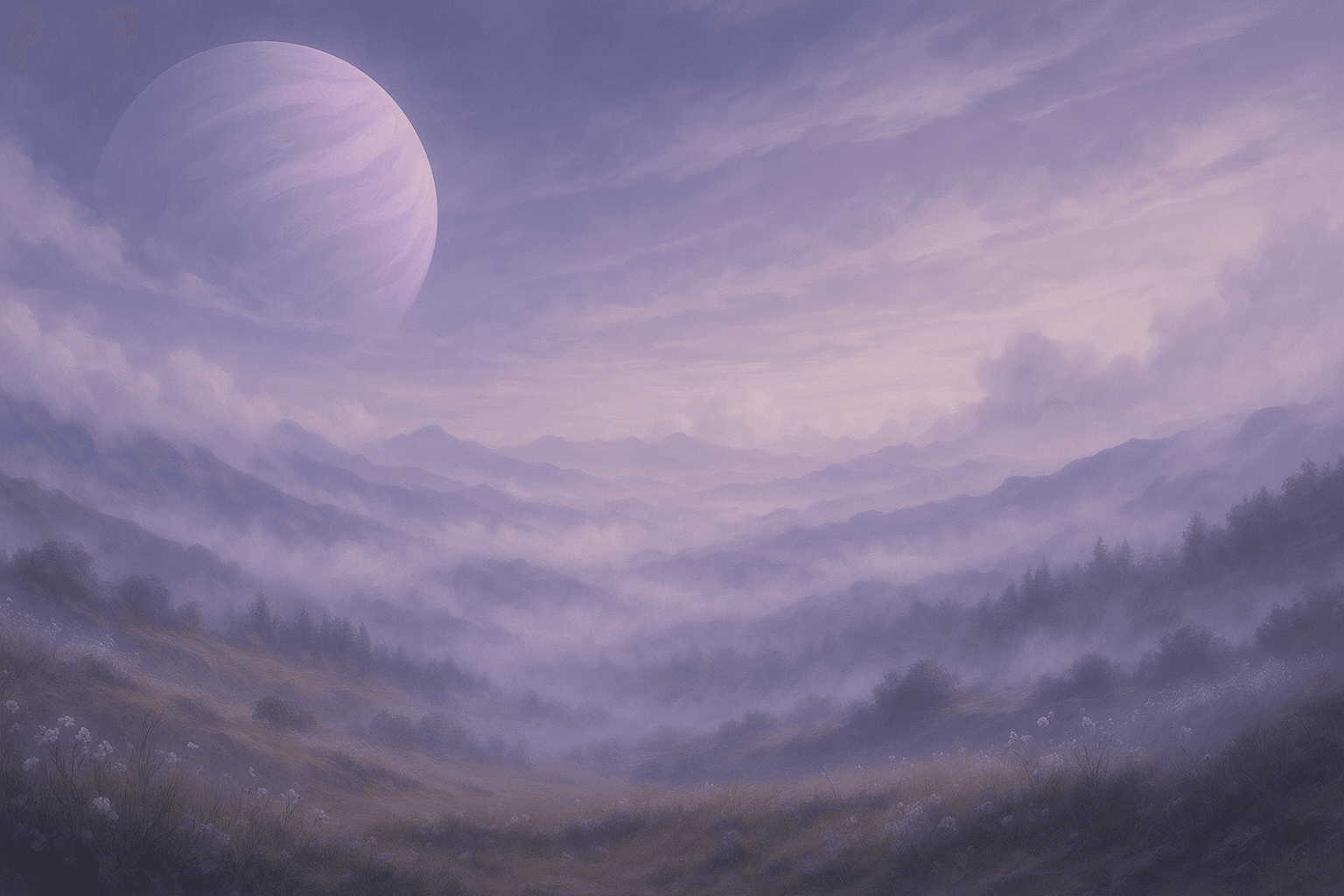
Planet Description
Aerthys is a terrestrial exoplanet characterized by extensive silicate dune formations with high albedo minerals that produce a distinctive pastel coloration under its lavender-tinted atmosphere. The planet's surface features significant carbite spire geological formations composed of calcium-aluminum silicates, rising prominently above numerous freshwater lake systems. A notable feature is the widespread presence of bioluminescent organisms, particularly chemiluminescent moss species that colonize low-elevation terrain. The atmosphere exhibits high water vapor content (2.0% by volume), resulting in persistent cloud cover and frequent precipitation. Spectral analysis reveals chromatic atmospheric scattering during twilight periods, caused by suspended particulate matter refracting stellar radiation across multiple wavelengths.
Planet Statistics
Orbital Data:
| Stat | Value |
|---|
| Mass | 7.85 × 10^24 kg (≈ 1.31 Earth masses) |
| Gravity | 9.2 m/s² (≈ 0.94 g; gentle, skyward breeze) |
| Orbital Period | 420.5 days (one “year” under twin morning mists) |
| Rotational Period | 30.2 hours (a dreamy, unhurried day) |
Atmospheric Conditions:
| Stat | Value |
|---|
| Nitrogen | 70.0% by volume |
| Oxygen | 22.0% by volume |
| Argon | 5.0 % by volume (whispers through the high meadows) |
| Carbon Dioxide | 22.0% by volume |
| Water Vapour | 2.0 % by volume (ever-present clouds & mists) |
| Neon | 200 ppm (faint, glowing auroral tints) |
Geological Data:
| Stat | Value |
|---|
| Mean Radius | 7,200 km (≈ 1.13 Earth radii) |
| Equilateral Circumference | 45,216 km |
| Volume | 1.56 × 10^12 km³ |
| Surface Area | 650 million km² |
Hydrological Data:
| Stat | Value |
|---|
| Mist and Cloud Coverage | ~60 % (entirely draped in soft vapors) |
| Lakes and Inland Seas | ~15 % of surface (mirror-like calm) |
| Ice and Crystal Formations | ~5 % (frosted peaks & glowing glaciers) |
| Average Lake Depth | 1,200 m (deep, echoing waters) |
| Total Water Volume | 0.98 billion km³ |
Magnetic and Geophysical Data:
| Stat | Value |
|---|
| Geothermal Gradient | 20–40 °C/km (warm subterranean springs) |
| Magnetic Field Strength | 2.5 × 10⁻⁵ T (auroral loops dance nightly) |
Auroral and Geomagnetic Data:
| Stat | Value |
|---|
| Halo Storm Cycle | ~35 days (when twin suns’ fields interact) |
| Skyglow Arcs | most vivid at high latitudes during twilight |
| Magnetic Reconnection Events | frequent at dawn, painting the skies |
Planetary Motion Data:
| Stat | Value |
|---|
| Halo Storm Cycle | 0.052 (slightly elongated orbit for seasonal mist shifts) |
| Obliquity | 27° (lush seasonal contrasts in light and mist) |
| Precession Period | 23,500 years (long-term sky-song changes) |
Tectonic Motion Data:
| Stat | Value |
|---|
| Seismic Wave Speed | 6.0 km/s (through solid bedrock) |
| Plate Boundary Length | ~75,000 km (gently drifting crustal “islands”) |
| Quakes per Year | ~18 million (mostly faint, melodic tremors) |
Solar and Stellar Data:
| Stat | Value |
|---|
| Host Star Luminosity | 0.85 L☉ (a slightly dimmer, golden-hued sun) |
| Star Surface Temperature | 5,200 K (soft, warm spectrum) |
| Solar Irradiance | 1,100 W/m² (filtered through perpetual haze) |
Surface Preview