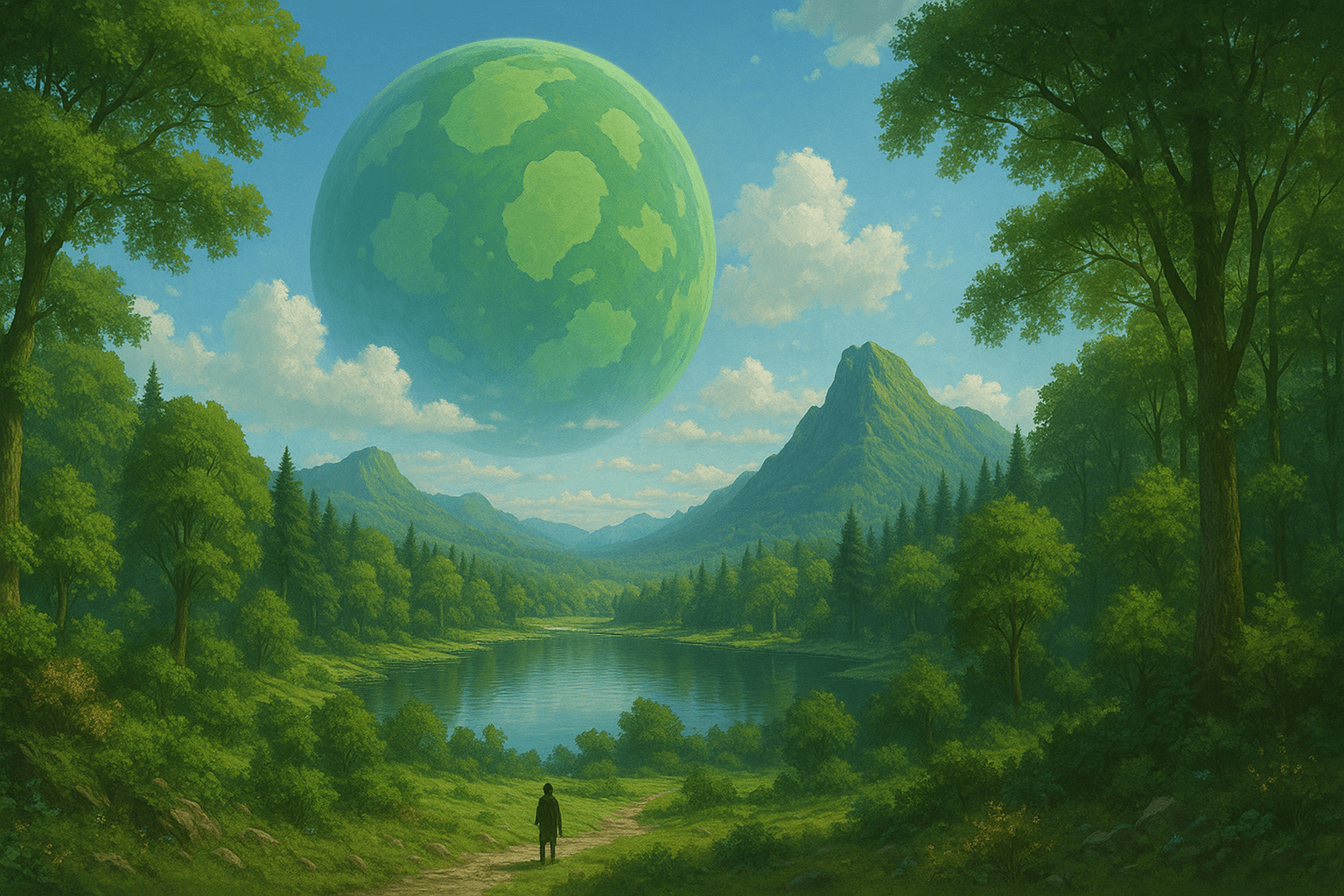
Planet Description
Terraverde is a temperate terrestrial planet with near-Earth characteristics (0.95 Earth masses, 0.98 g surface gravity) supporting extensive biodiversity across multiple biome types. Dense deciduous and evergreen forest ecosystems cover approximately 35% of the planetary landmass, with canopy heights exceeding 60 meters in mature growth regions. The hydrological cycle includes 60% oceanic coverage and a 10% freshwater network of rivers, lakes, and wetland systems that support high biological productivity. Atmospheric composition closely mirrors Earth parameters (78.9% N₂, 20.7% O₂) with methane concentrations of 1.8 ppm indicating active wetland biogenic processes. The planet's 24° axial tilt produces moderate seasonal variations that drive ecosystem dynamics, while the 350.3-day orbital period aligns with natural biological growth cycles.
Planet Statistics
Orbital Data:
| Stat | Value |
|---|
| Mass | 5.67 × 10^24 kg (≈ 0.95 Earth masses) |
| Gravity | 9.60 m/s² (≈ 0.98 g; comfortably Earth-like) |
| Orbital Period | 350.3 days (one “growing season” around its sun) |
| Rotational Period | 24.5 hours (a day paced for wildlife rhythms) |
Atmospheric Conditions:
| Stat | Value |
|---|
| Nitrogen | 78.9 % by volume |
| Oxygen | 20.7 % by volume |
| Argon | 0.93 % by volume |
| Carbon Dioxide | 20.7 % by volume |
| Methane | 15 ppm (used in high-precision spectrographs) |
| Neon | 1.8 ppm (from thriving wetlands) |
Geological Data:
| Stat | Value |
|---|
| Mean Radius | 6,350 km (≈ 0.99 Earth radii) |
| Equilateral Circumference | 39,900 km |
| Volume | 1.07 × 10^12 km³ |
| Surface Area | 507 million km² |
Hydrological Data:
| Stat | Value |
|---|
| Mist and Cloud Coverage | 60 % of surface (deep blue seas teeming with life) |
| Lakes and Inland Seas | 10 % (network of clear waterways) |
| Ice and Crystal Formations | 4 % (seasonally variable, nurturing meltwater) |
| Average Ocean Depth | 3,800 m |
| Total Water Volume | 1.30 billion km |
Magnetic and Geophysical Data:
| Stat | Value |
|---|
| Geothermal Gradient | 25–45 °C/km (supports hot springs in forested valleys) |
| Magnetic Field Strength | 3.0 × 10⁻⁵ T (protects from stellar winds) |
Auroral and Geomagnetic Data:
| Stat | Value |
|---|
| Chrono Auroral Cycle | ~27 days (northern and southern lights dance on the horizon) |
| Autrora Seasons | moderate—peaks every 4 months with solar flares |
| Magnetic Reconnection Events | occasional at dusk, lighting up forest canopies |
Planetary Motion Data:
| Stat | Value |
|---|
| Halo Storm Cycle | 0.018 (mild seasonal variation in insolation) |
| Obliquity | 24° (balanced seasons for ecosystems) |
| Precession Period | 26,000 years (long-term climatic cycles) |
Tectonic Motion Data:
| Stat | Value |
|---|
| Seismic Wave Speed | 6.3 km/s (through mixed continental crust) |
| Plate Boundary Length | ~67,000 km (tectonic seams rich in mineral springs) |
| Quakes per Year | ~15 million (mostly minor, many dampened by water-saturated soils) |
Solar and Stellar Data:
| Stat | Value |
|---|
| Host Star Luminosity | 1.00 L☉ (a steady, life-nurturing sun) |
| Star Surface Temperature | 5,780 K (crisp daylight ideal for photosynthesis) |
| Solar Irradiance | 1,360 W/m² (filtered through dynamic cloud cover) |
Surface Preview